my upcoming course might be just what you’re looking for. And as lockdown looms again for so many of us, here’s a way to use that time as an opportunity to open up to a richer life!
Click below to find out more.
my upcoming course might be just what you’re looking for. And as lockdown looms again for so many of us, here’s a way to use that time as an opportunity to open up to a richer life!
Click below to find out more.


Happy Birthday, collage with acrylic paint, Lynne Cameron 2020
At one point, this collage was ‘stuck’ - it didn’t hold together as a whole. More words, more long triangular shapes, more paint solved it.
Memo to self: Keep going!

Apprentice kisses, watercolour paint, felt pen, collage on card
Lynne and Naya Cameron, 2020
My collaborator for this work is three years old, and making her first marks that mean. I was teaching her to draw kisses for Mother’s Day. She decided on the orange and mixed red and yellow. I collaged.
is a photo~poem, developed while walking on a local beach

Stranded, Lynne Cameron, 2020. Christchurch, New Zealand
strand is an old English/Norse word that refers to the part of the beach revealed as the tide goes out, that lies between high tide and low tide. As such, it is a temporary and always shifting space.
There was originally a further stanza to the poem - the choice of photo affects how many words can ‘fit’. The end result is neither poem nor photo, and both poem and photo. I am fascinated, and sometimes frustrated, by the dynamics of interaction between image and verbal meaning.
Composing feels like a process of offering affordances and attending to what emerges —
I decided to make a concrete poetry piece by hand. After writing fence in a fence shape at least seven times before it was good enough - because at the last link concentration would lapse and some letter would fall out of place - I have a renewed respect for monks who spent their lives copying manuscripts..
This piece connects to my on-going concern with conflict transformation and empathy. How good we are at building walls and fence to keep the Other out!
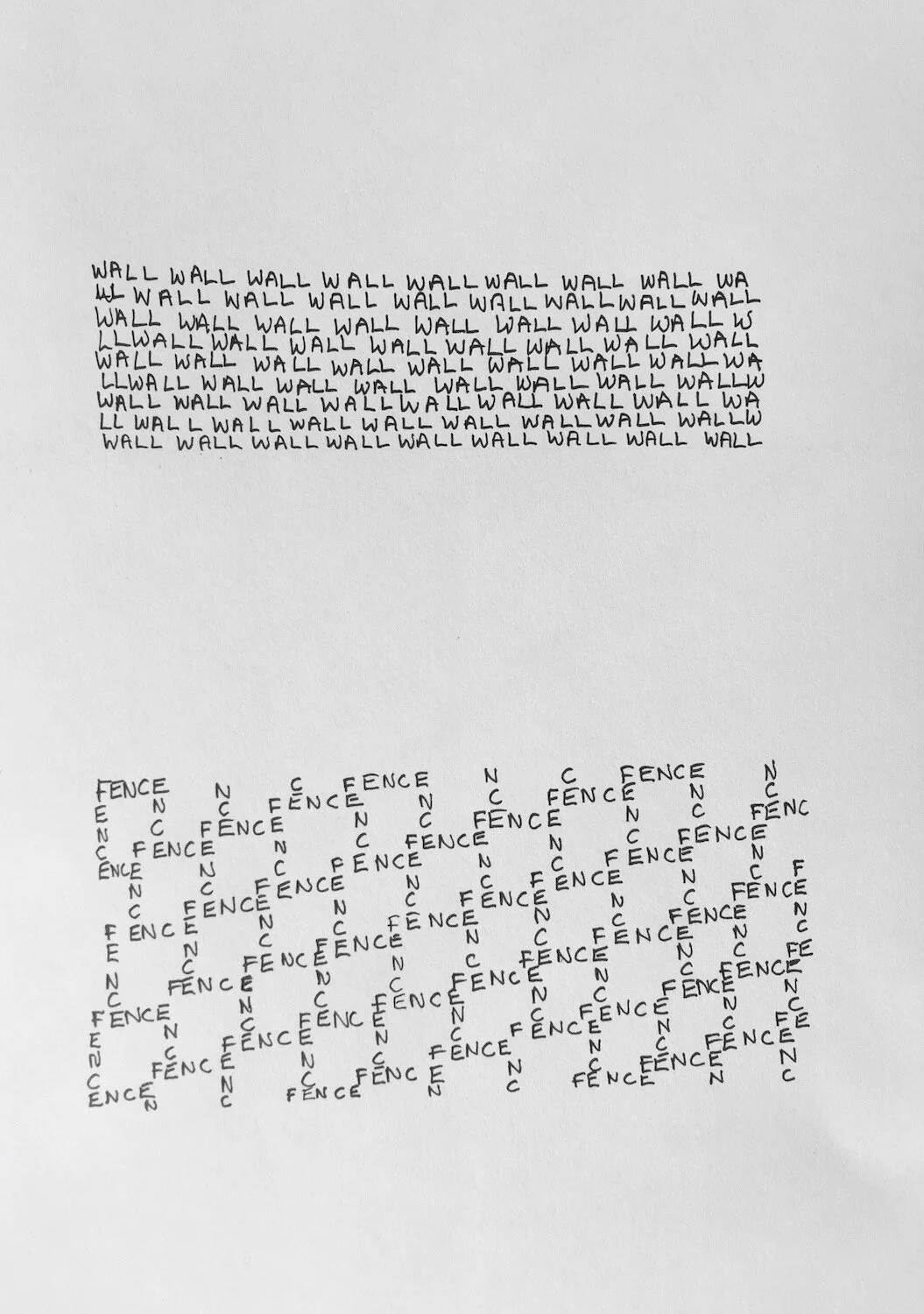
Keeping out the Other, Lynne Cameron 2020

5 Accompanied Lines, Lynne Cameron, 2020
pen on paper, laid on acrylic on canvas
Asemic poetry is made from marks without meaning, often marks that resemble writing of some kind. Meaning comes from the marks themselves and their place in the overall composition.
For a long time, I have been intrigued by how lines can be drawn to cross a page, and the various metaphorical meanings that they suggest. On each of the pages / stanzas, five lines start at the top and work their way downwards, interacting as they go, reflecting how ideas, sounds or images might be entwined in a poem. They are laid out vertically as if a transcription of spoken poetry. The underlying painting reminds us that poetry connects with us as the people we are, of our time and place.
The title references Scottish artist Wilhelmina Barns-Graham and US poet William Carlos Williams, who made works entitled 12 Lines and Lines.
I tried two different paintings as the base layer for this asemic poem. In the one above (one of a series of four panels painted during lockdown), there is an echoing of the intertwining line on a different scale. The painting used below is more dramatic and hints at something like a spoken performance of an asemic poem.

5 Accompanied Lines and Scarlet, Lynne Cameron, 2020
pen on paper, laid on acrylic on paper

As aliens collage handwriting and acrylic on panel, 20 x 20 cm, 2017
I’m currently diving deeper into how I bring words into my art practice by following an online course from The Poetry School in London. For many years, I tried to keep my wordy self separate from my painting self because words were the ‘day job’ and painting was the yearned-for life. After I adjusted the balance so that painting had its proper share of my time and energy (most of it), words crept back and demanded a presence in my practice. Sometimes in the form of poems that come out of painting, always in finding titles for paintings, and always in the notebooks that are a vital part of my practice.
Now I’m finding that there’s a lively collection of people making art out of/ with/including writing and developing it as a field in its own right. And I’m looking afresh at my earlier work and making new pieces.
As aliens, above, was made during my residency at Cinepoetics in Berlin. The writing started as “Notes in the Dark’ written in a sketchbook during the screening of the movie “Under the Skin”. I was a somewhat reluctant viewer of this film, and the combination of my emotions with the visual power of the movie produced a series of works (more here). In this one, I collaged photocopies of the writing and then painted in response to the words and the experience.
Here’s a video about making Notes in the Dark, with original music from the very talented Eileen Rositska:
The written notes retain some semantic meaning even while fragmented and mashed up in this way, while the words make other kinds of meanings through juxtaposition and repetition. They become visual ‘objects’ and forms, and also a surface for paint, while retaining their distinctness as written language. In working towards a finished composition, I consider where to place the words, how much to obscure and reveal of them, how to place paint over and next to them, how much colour to introduce … That the notes were made in response to film adds another dimension, another layer of experiencing and making meaning out of the visual and spoken/written language.
Painting before, during and after lockdown in New Zealand
I’ve just updated my Artist Statement on this website to better reflect what gives meaning and purpose to my art. I felt the need to include this sentence, particularly the last part:
(My) expanded visual arts practice includes monoprints, text collages, and video, alongside vibrant abstract paintings, in a series of projects that attend to the beauty in our damaged world and to our brave attempts at building relationships across misunderstanding and conflict.
I make no apologies for using the word beauty. I feel an increasing urgency to rehabilitate the idea of beauty within art, in order to highlight what we may be destroying.

Your bravery was never in doubt. Acrylic on unstretched canvas, 200 x 200 cm. Lynne Cameron, 2019
The next exhibition…
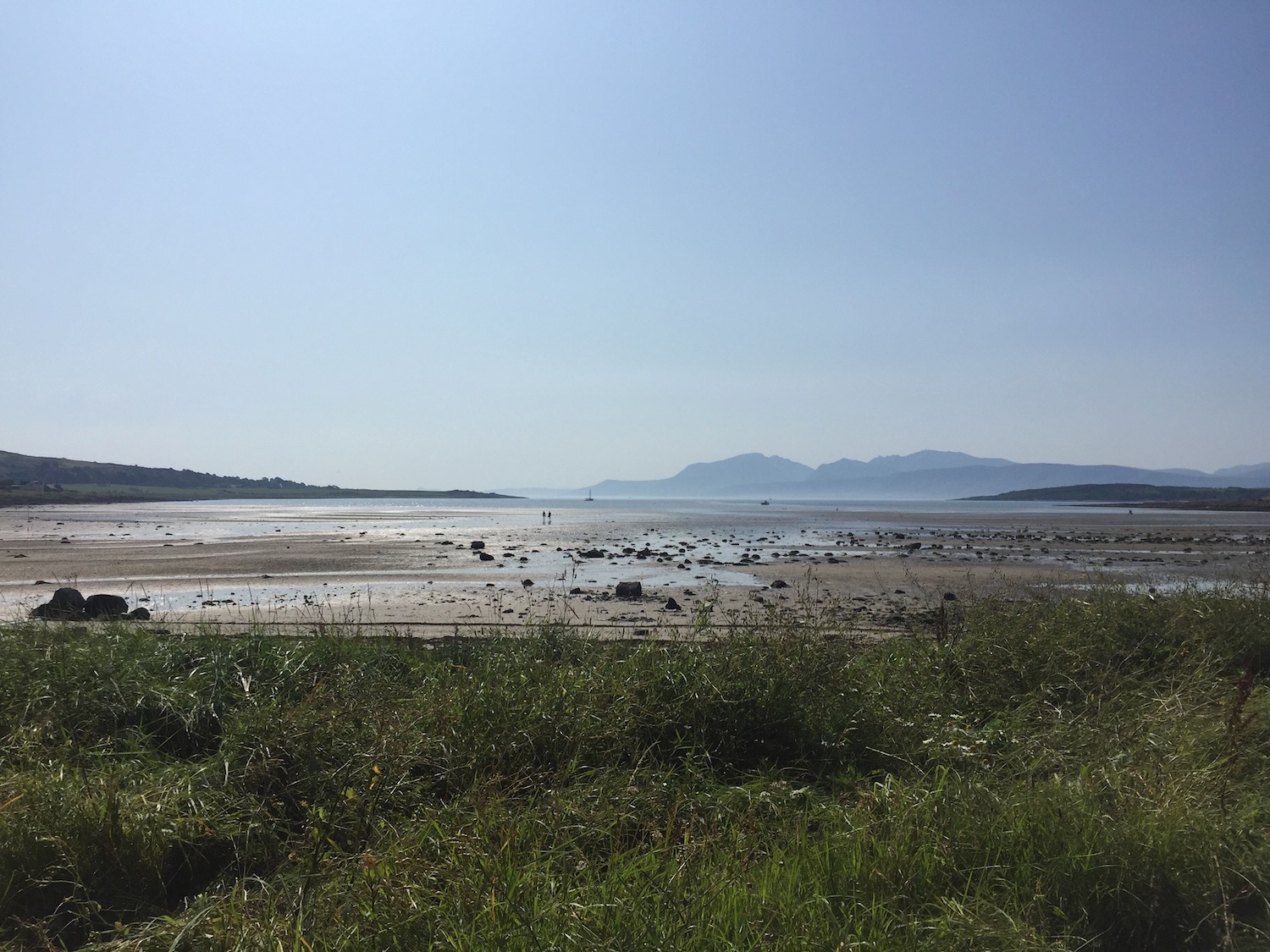
St Ninian’s Bay, Isle of Bute, Scotland
and sat on the rocks with sketchbooks. I ‘drew’ the birdsong - curlew, gulls, oystercatchers, and lots of lbb (little brown birds). With a background of humming harvesting.


I’ve just framed a couple of the SURface prints for an upcoming exhibition, and they look so good that I wanted to show you!
These are approximately A3 with a white card mount, specially cut to show off as much of the print as possible, while neatening the edges. If you want any of the prints in the shop to arrive framed and ready to hang, it add £35 to the cost.

Maybes and possibilities. Monoprint, Lynne Cameron 2019
that’s the title of my new online course. Four weeks of exploring the whispers of intuition that might be suggesting you grow a more poetic life. Click here for more information

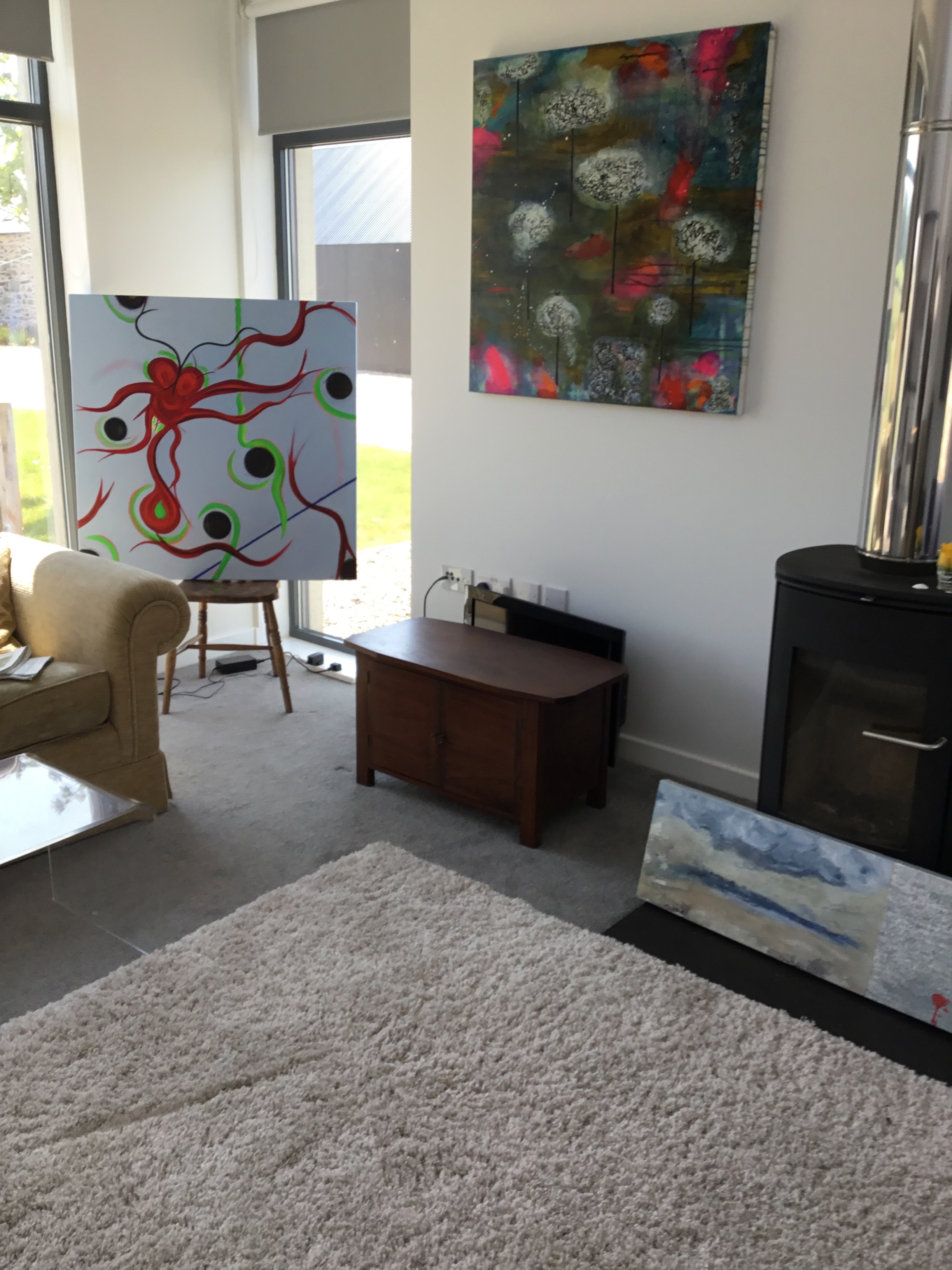
It’s good every now and then to curate the most recent paintings. I’m lucky enough to have a house that converts quickly to a domestic gallery with lots of wall space. Then again, I suspect most living spaces can turn into interesting spaces to share art.
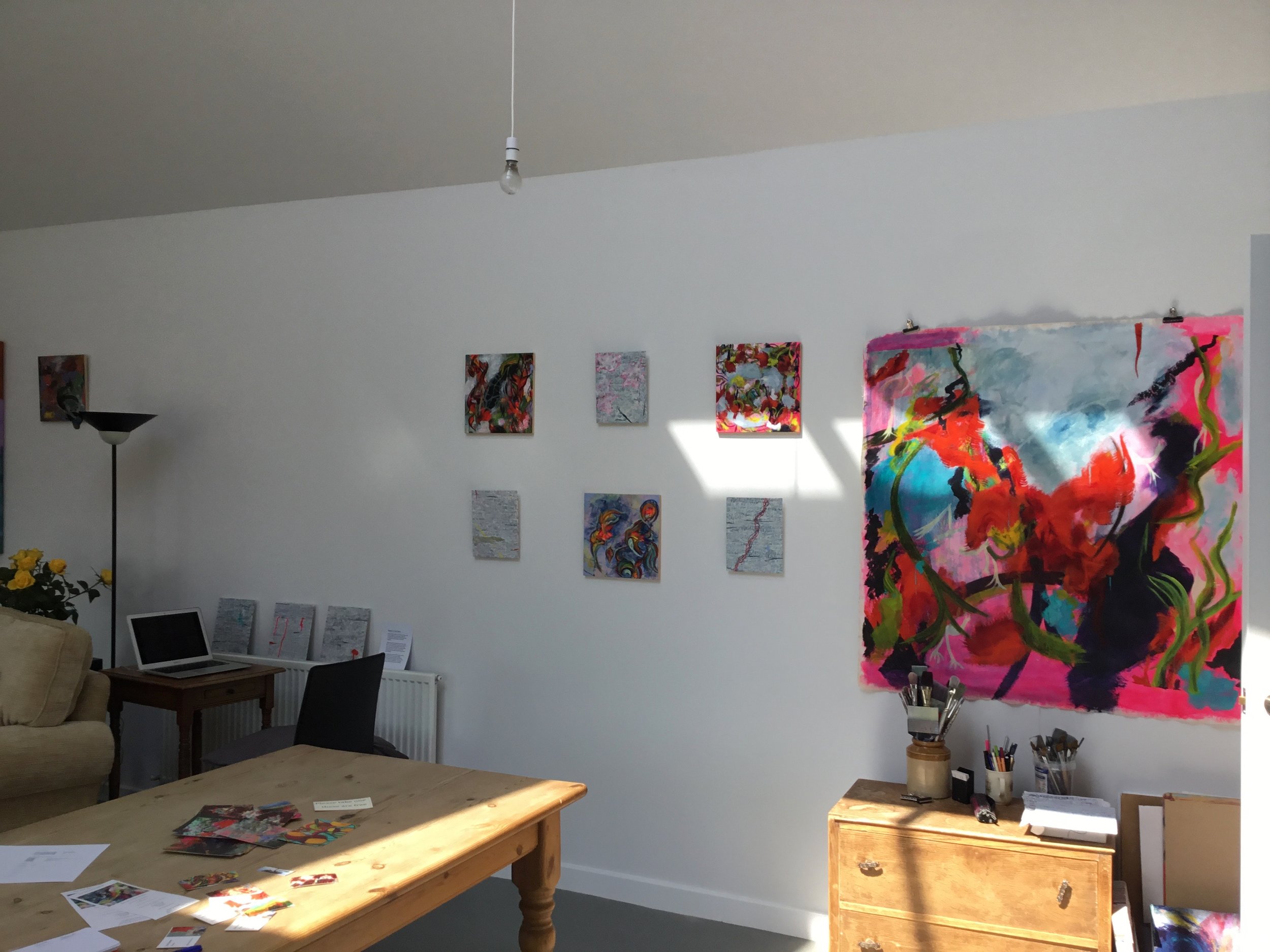

Some weeks after travelling back from New Zealand, I’m taking a chunk of time to paint and write.
Work in progress...


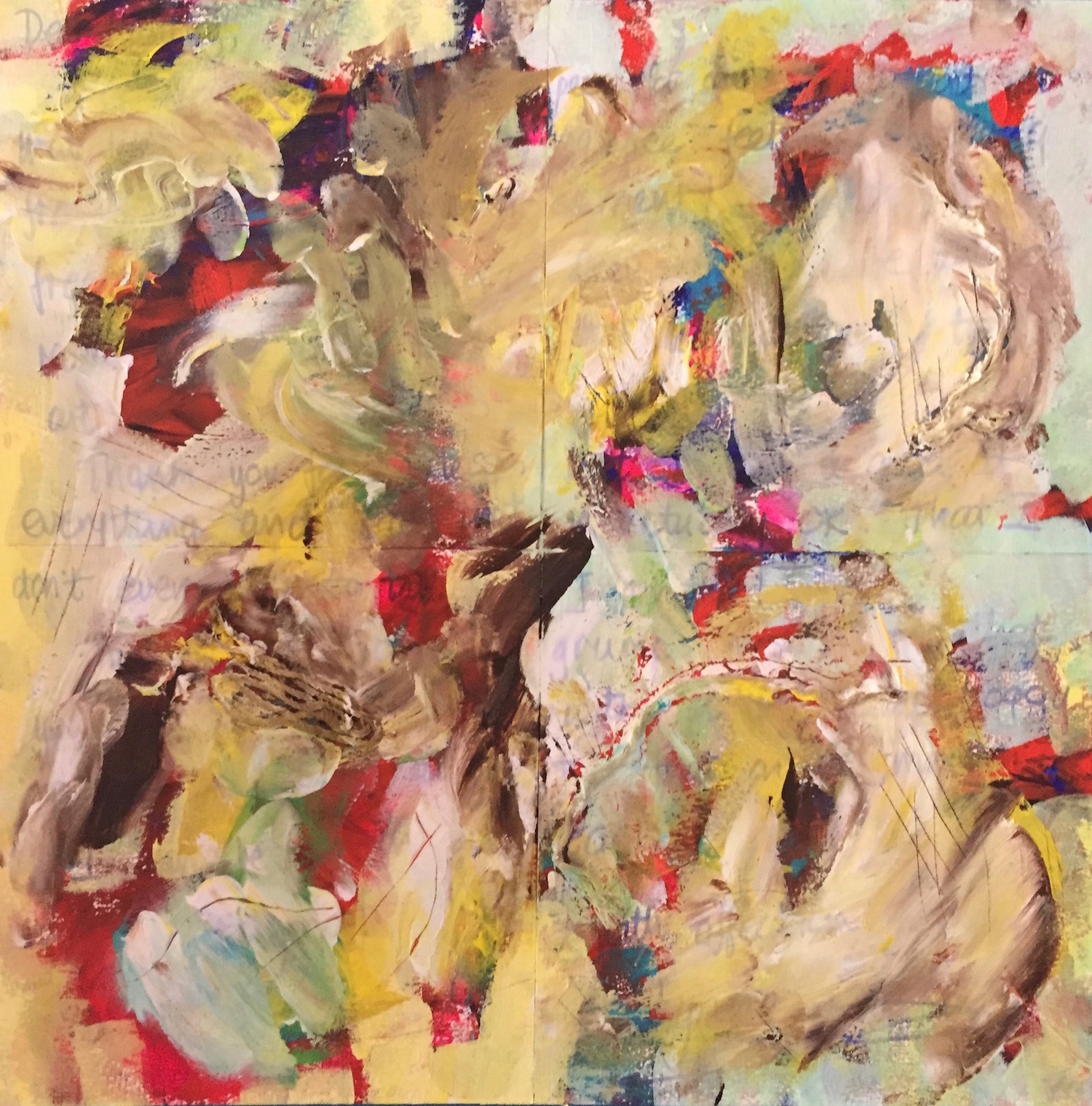
Thank you , dear miserable person. collage and acrylic on paper, 30 x 30 cm, mounted on wooden panel. Lynne Cameron, 2018. £350.
I started writing and painting the Thank You Letter series a couple of years back (the original idea comes from Flora Bowley). Having done the first one to my inner critic (above), I so loved the process that I developed my own version. I’ve now made Thank You Letter paintings for places I’ve loved and hated, for people in my past who brought love and for some who caused me problems, and for a year that was particularly significant in my life. I’ve discovered that you can write to anyone or anything that matters to you. And, while the process of expressing gratitude in words is delightful, expressing the less good stuff in terms of thanks has a healing and restorative effect.
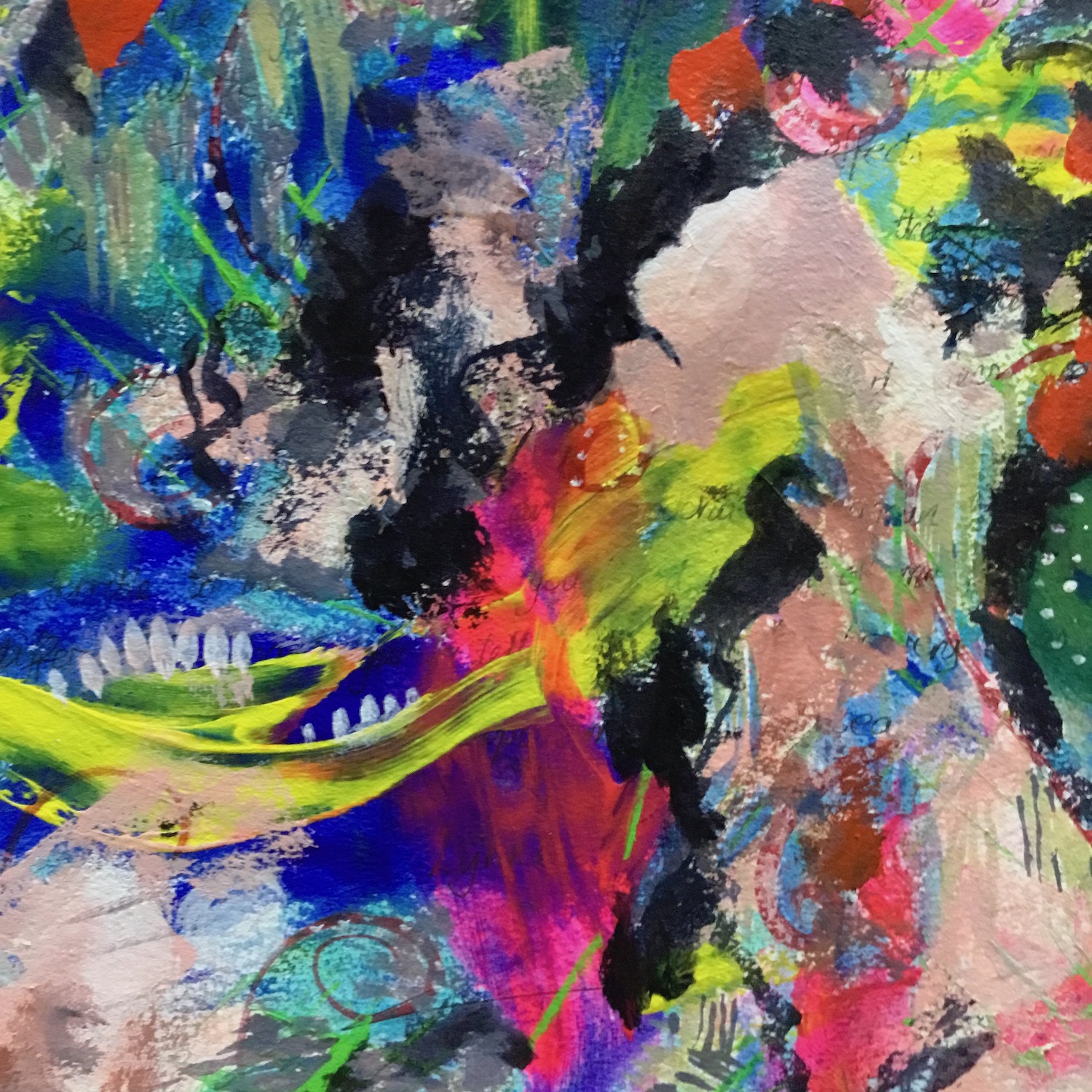
Thank you for telling me. acrylic on paper, 30 x 30 cm., mounted on wooden panel. Lynne Cameron, 2018. £350
I start by writing the letter, as a letter, on the paper. The words are photographed but then covered with layers of paint, and not shown to anyone else. I allow some words to appear through the paint. The feelings of the letter influence the painting, and choice of colours and gestures. The finished paintings are abstract, dynamic, and bold in colour. The intense artworks reward much looking at, as paths and landscapes and forms emerge from the colours and gestures.
Recently I had the idea that people could work with me to create their own Thank You Letter painting, which could come out of loving rememberings of people and places we’ll never see again. And be cathartic acts of closure on difficult times. I would help in composing the words, and then produce the finished artwork, which would be deeply personal.
If you might be interested in this not-quite-a-commission idea, send me a message and I’ll share more details.
And there’s a special offer for the first two Thank You Letter artworks to be made this way in exchange for helping me test the process…
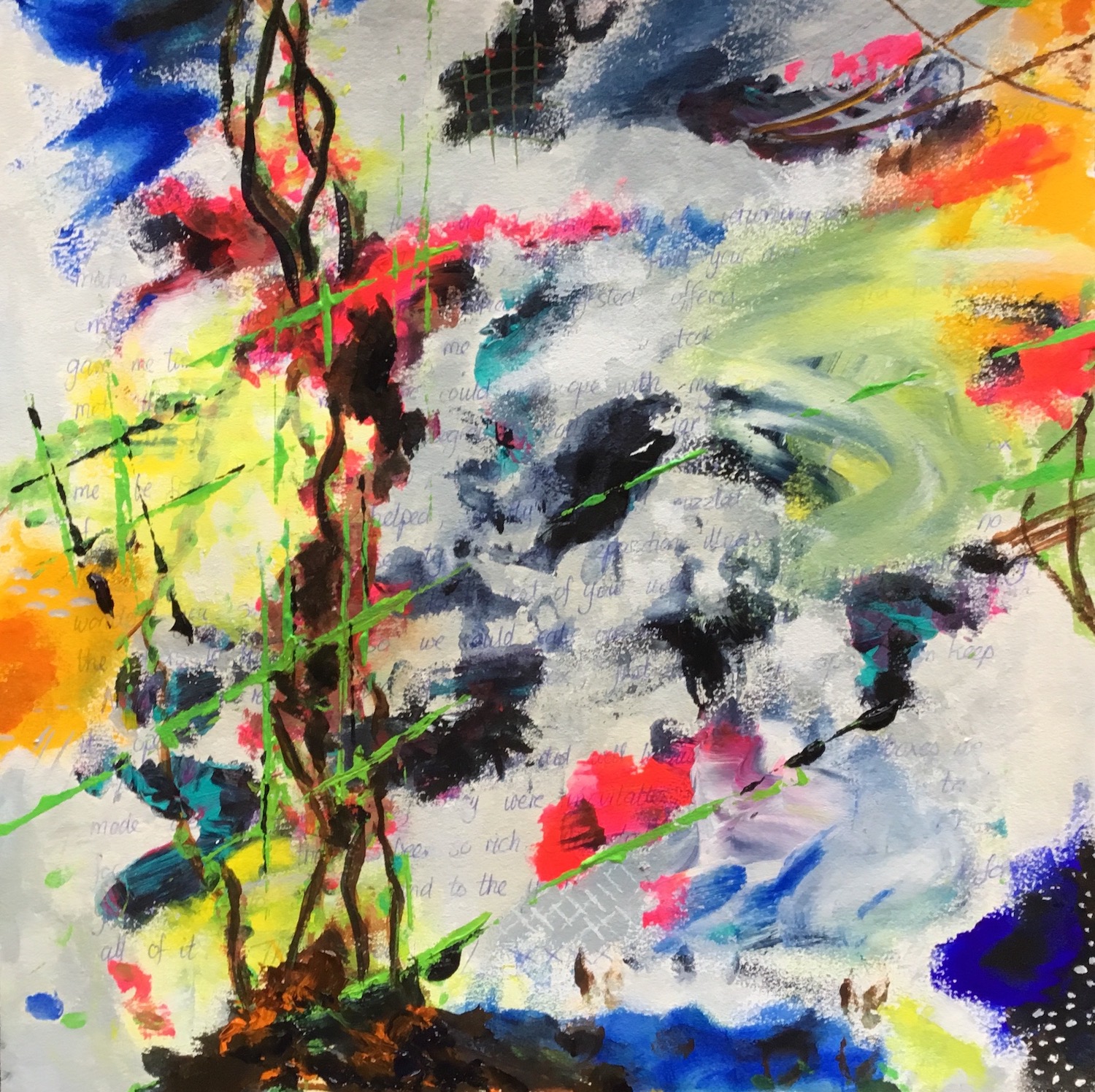
Unlocking the doors (to my parents). Acrylic on paper, 30 x 30 cm, mounted on wooden panel. Lynne Cameron, 2019. £350
I came to art quite late in life and step-by-step. There was a point when I knew that this mattered more than my day job, and I inched my way out of that too. What guided me was realising that I wanted a more ‘poetic’ life.
To find out more, click over to my new site where I’m talking about this shift. I’m planning an online course to help other people make a shift of their own. Sign up to be the first to know what’s coming.

Another monoprint inspired by the fractured surfaces of car parks here in Christchurch , New Zealand. Two layers of cracking interact, and spread across the surface. And yet the surface holds, strong enough to move across towards a different future.
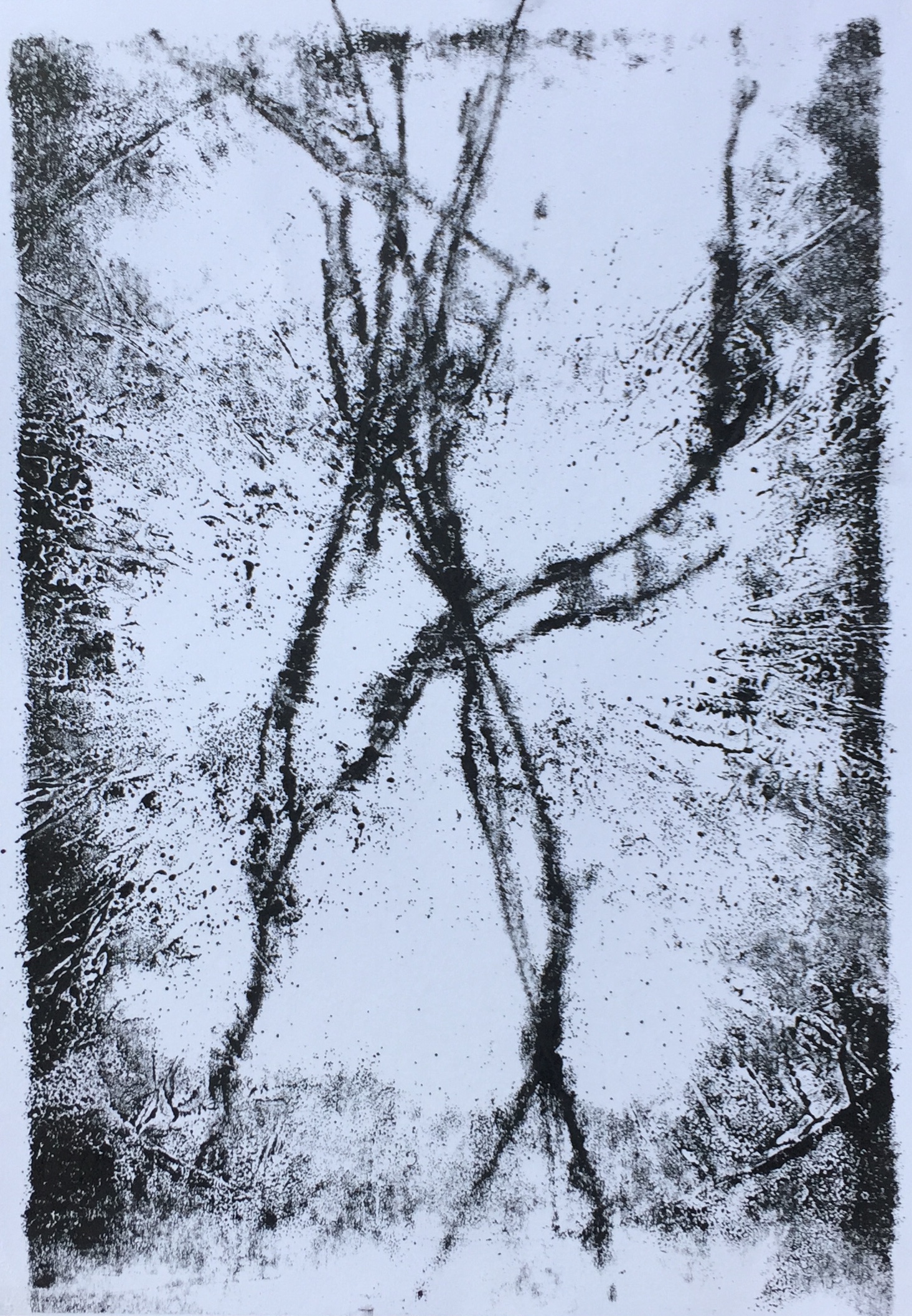
This print, from the SURface project, has at least three layers, printing and overprinting. Sometimes I see paths that lead in and out of the darkness. Sometimes it seems as if a tall tree reaches into the sky. There are horizons and falling shapes, light and darkness beckoning. And sometimes it’s just lines going nowhere and forms without edges. And then strong but tiny lines show up in the far distance..

In that moment. Monoprint. £150 from the shop.
