Sleepless night. Early phone call. Sudden clarity that the new paintings need to be in the other room. They need more space around them to shout and leap.

Today is varnishing
Some people still use the French term "vernissage" for their private view just before opening - that's when artists used to varnish their work. I'm doing it today. It's a delicate and quite scary process since no more changes can be made and the surface needs to be exactly right.

so far, so good...
Open Studios preparation
Today's tasks include checking the edges of all the canvases and making sure they are clean and white.
Let's hope the rain stops this afternoon so I can deliver local invitations.
It's published!
The Wonder World for Enid poem is published in The Psychologist magazine. Click here to read the article
And the painting is done
I think... although there appear to be no roses. Here's a glimpse of the corner. The full painting will be revealed on 5th June to mark the opening of Bucks Open Studios. My lucky Newsletter readers get a web preview! Sign up here if you'd like to join us.

Day 3
I turned the sketch book upside down, and the (absence of) shell yields a lovely shape for the painting background


Day 2
The shells are out and can go back to the beach (I want to go with them...)

The flowers are out and I find their incompleteness somehow compelling.

Another 'undoing' begins
Today I am releasing roses, scabious, busy lizzies and cornflowers from a shell!

A prize for Enid
I was delighted to find out this week that my poem 'A Wonder World for Enid' was the winner of the first ever poetry competition in The Psychologist magazine. It will appear with one of the paintings in the June issue.
.... loving this coming together of science and arts!
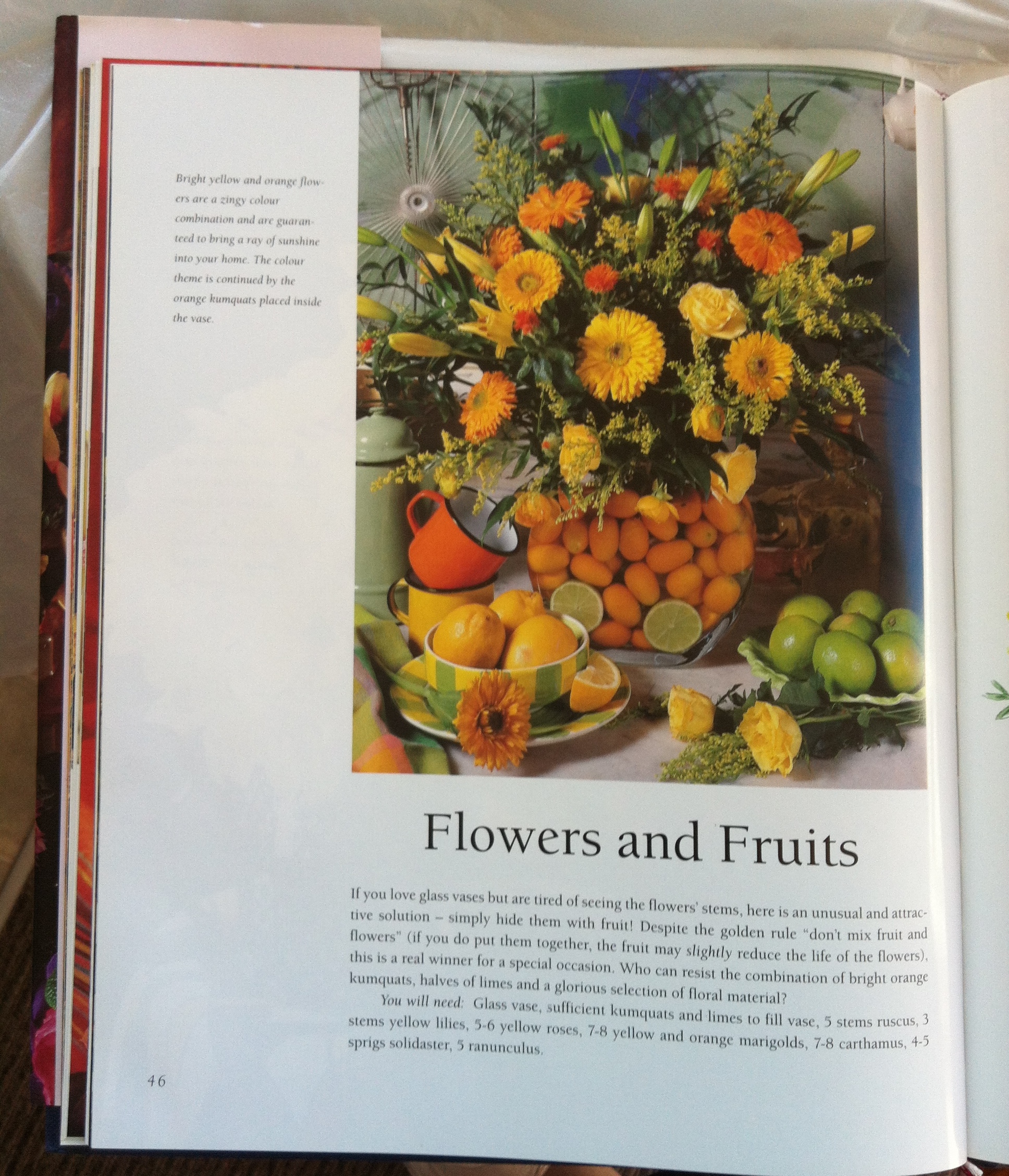
guaranteed to bring a ray of sunshine into your home
It's strange how an art project can just arrive. I'm in New Zealand with family, and spotted this book in a closing down sale in Nelson when we stopped for coffee. The gorgeous flowers on its front cover caught my eye, but when I looked closer it made my hackles rise with its assumptions and misleading descriptions: Simple, quick, easy, practical. My mother arranged flowers, and it never seemed to be any of those. I resisted learning back then, and it seems I'm still resisting.
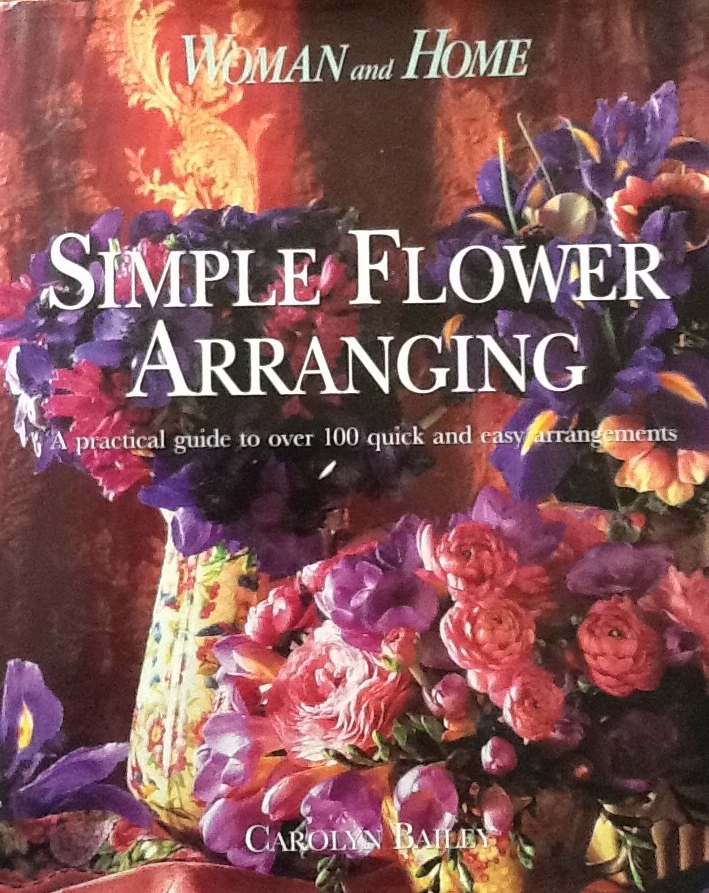
Inspired by my niece's photography experiments., I brainstormed ways that I could 'explode' the quick and easy arrangements:

from my little sketchbook
and below you can see what happened to "Flowers and Fruit". In my big sketchbook, the flowers were liberated from the kumquats, limes, lemons, and crockery. The cut-out inspired painting. The exploded flowers asked to be printed. The trial was re-done on a square canvas.
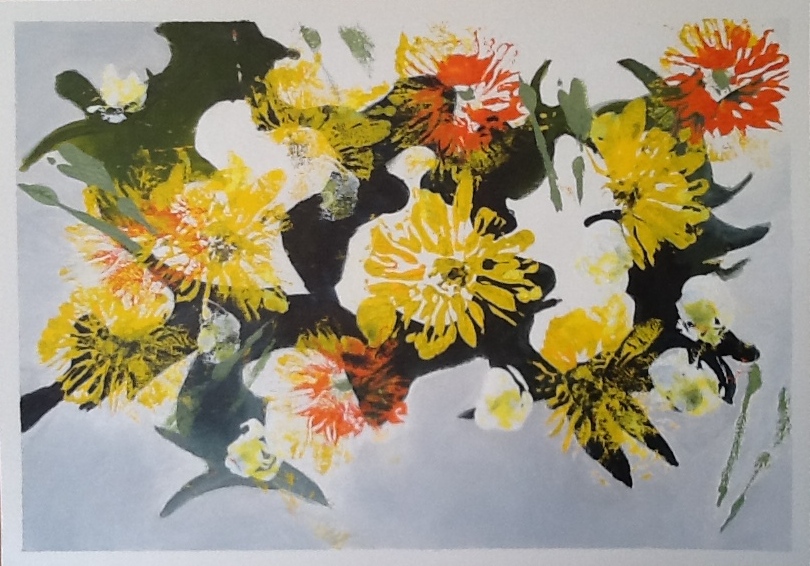
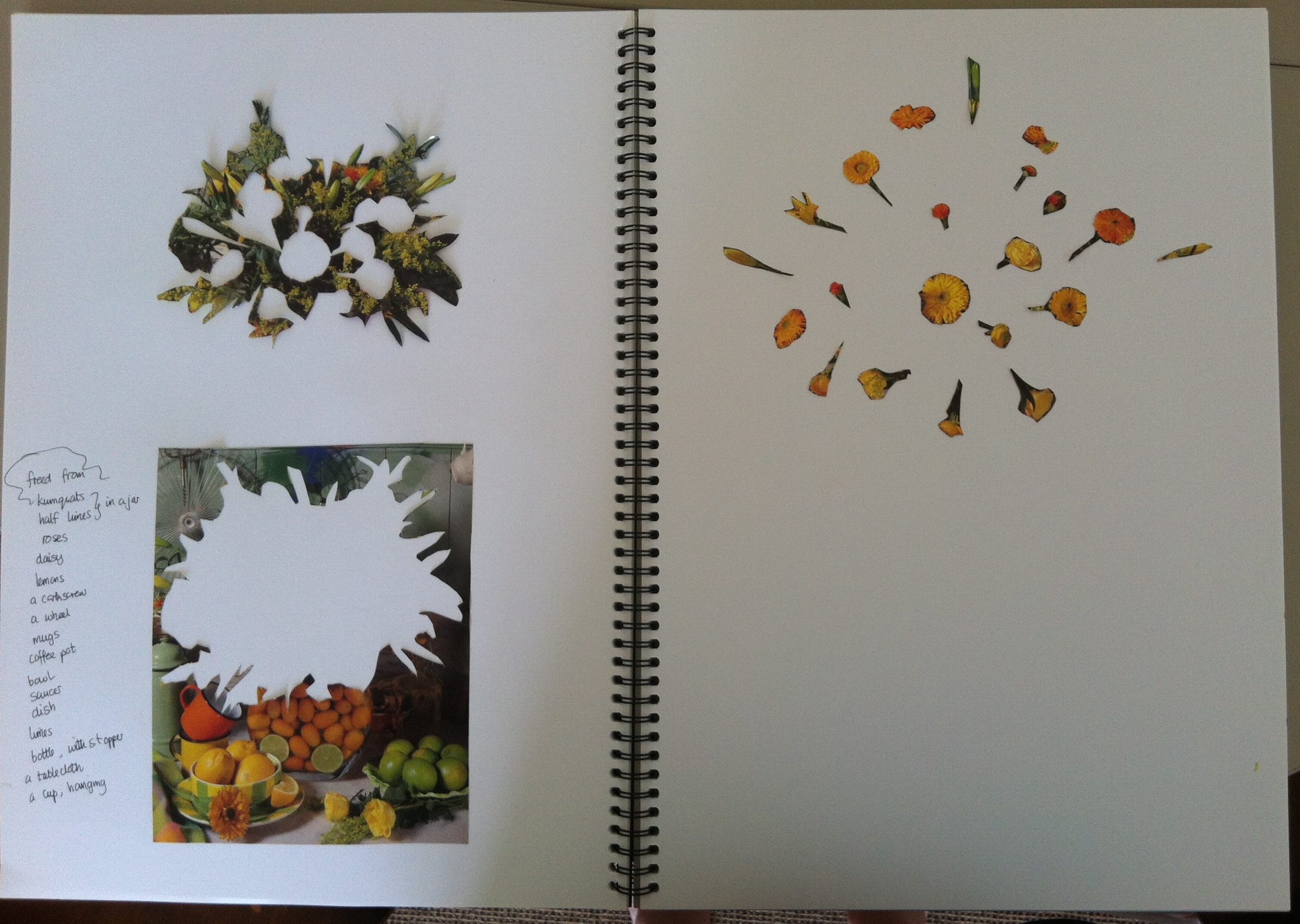
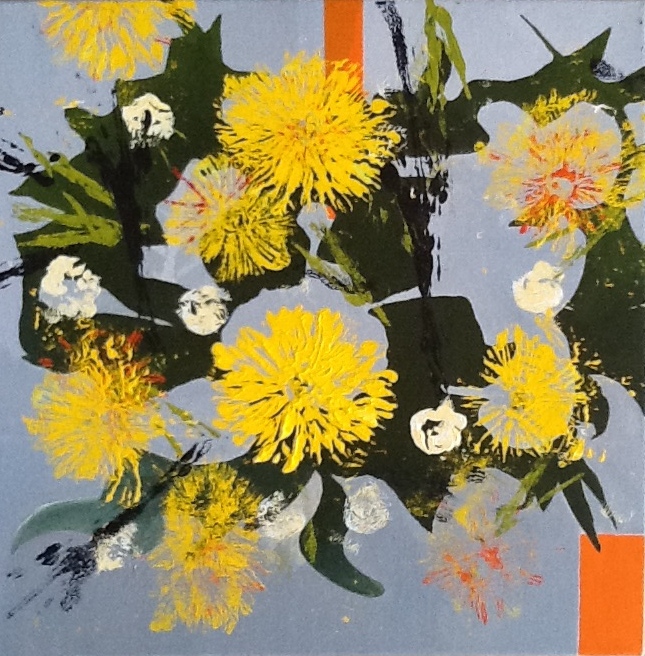
The title of the final piece comes from the book - "guaranteed to bring a ray of sunshine into your home".
The gap
During my exhibition ‘A Wonder World for Enid’ in the University of Leeds Clothworkers’ Hall, I am blogging about the paintings, where they came from and how they were made.
In all the Wonder World for Enid paintings there is a gap, often lighter or darker than the rest of the space. As the theme of memory and forgetting came together with the painting process, the gap emerged as the most poignant aspect of the works. The gap is the distance between the person with dementia and those who care for them. The gap is silence. The gap is a new kind of 'alterity'.
I believe that, all through life, other people remain ultimately unknowable. This otherness, or alterity is unavoidable, inevitable, and thus to be managed, not mourned. We do our best with the tools of language and thinking to reach across the gaps of alterity, to properly see the other, and to share ideas. Most of the time we manage reasonably well.
With dementia, alterity changes. Before dementia, the two of us had different memories of the same event, but they were close enough to leap the gap. Now what I remember is often no longer close to what you remember. And the more recent an event, the more we differ in our perceptions and memories. We can sit in the same room as the light shifts and voices are heard. To me, it’s just the afternoon passing, the sun going down, and people bringing the tea trolley. To you, it's a cause for fear and worry, convincing you that you are locked in a prison and in immediate physical danger.
Thank goodness that deeper memories of long ago events are less affected, and happier emotions attached to them can still be re-experienced. On a good day, I could activate them by reaching across the gap and pulling out bright moments of your past to remind you.

Thrown off course. Acrylic on paper. 34 x 37 cm framed.
Leeds exhibition opens
The exhibition in the Clothworkers' Hall Foyer at the University of Leeds opened last Thursday with a Private View and Artist Talk. Here are some photos from the hanging day. To make best use of the large open space, I hung the smaller works in blocks of six.


It was lovely to catch up with friends and former colleagues at the Opening, and I feel so grateful for their continuing support, even on a windy, rain-lashed January evening. Several paintings were sold, including one of my favourites A Late Page.
The exhibition is up until 23 March.
Layering the greys
Before and during my exhibition ‘A Wonder World for Enid’ in the University of Leeds Clothworkers’ Hall, I am blogging about the paintings, where they came from and how they were made.
A body of work demonstrates both continuity and change. Continuities across the Enid paintings include the flower-like forms, intense colour under greys, layers and blending, a gap.

What’s true? acrylic on watercolour paper 34 x 36 cm
When I'm painting, the painting process is what drives me: creating texture and colour, deciding on the space between forms, suggesting light and shade or movement. I especially get involved in making the greys. My favourite grey comes from mixing indigo and burnt umber with titanium white. I love the process of mixing the paints until colour is almost lost in a black. Different colour combinations make different blacks, and some of the paintings use alizarin crimson with viridian green.
I take at least three passes over the image with grey. The first one encloses interesting sections of colour. These sections are then more carefully enclosed, developing their own shape and integrity. A second pass considers the whole and removes several sections one by one, each time considering the effect on the whole. The third pass requires most courage. It's the "kill your darlings" phase when any sections that are too 'lovely' or decoratively harmonious are removed. This stage goes very slowly. I can change my mind if I do it immediately and wipe off the paint with a damp cloth. The wiping off sometimes itself creates a blurring that I like, and leave.
Visiting dementia
Before and during my exhibition ‘A Wonder World for Enid’ in the University of Leeds Clothworkers’ Hall, I am blogging about the paintings, where they came from and how they were made.
As an abstract expressionist painter, my art comes out of and responds to my emotions. The most intense emotions of the last few years were generated by my father's dementia, and by my experiences as I watched it eat away at his mind, discussed decisions about his care, sat next to him on weekly visits to the care home.
The series of paintings that I call 'A Wonder World for Enid' emerged out of multiple, complicated emotions brought into the studio. Enid was frail old lady who lived across the corridor from my dad. It is still too hard, too raw, to make art directly relating to my father's last illness. The paintings are for a re-imagined Enid, made safe through metonymy, appropriation and projection.

Go back to your room now acrylic on paper 25 x 35 cm 2013
These paintings speak to the experience of watching my father fade away. Colour and form respond to the multiple emotions of that experience. The bright shapes underneath and among the grey suggest the rich lives of people with dementia that are gradually obliterated, but remain accessible longer than we think. They reflect moments of joy and connection that brightened my visits.
A body of work
Creating a body of work is considered an important step in an artist's development. It puzzled me for some years how this might happen. Yes, I could paint several works on the same theme, but more often, I'd want to move on to something else, try some other exciting idea. It seemed rather boring to stay in the same groove (rut?).
And then, a year or so back, it happened. I worked my way into the series of paintings that became "A Wonder World for Enid" and that became the body of work I am drawing on for my next exhibition.
This painting was the very first in the series and is called "What is this place?" (acrylic and pen on paper, 25 x 35 cm), and it's now sold.

I discovered that I was happy to stay with these paintings because they offered such rich exploration of possibilities. I'm still painting new ones.
Christmas cards


These two colourful paintings are being printed as cards! One version has the words "Peace at Christmas" inside; the other is blank.
All profits will go to the charity Building Bridges for Peace and the work of the amazing Jo Berry in promoting peace and conflict transformation around the world. If you watch Jo Berry's TED talk, you will understand why it feels so right to support this charity. I will also be donating to them 10% of the price of any prints and paintings sold in December.
The cards are A5 in size and lovely quality. They cost £12 for 6 (3 of each design) plus £1 p&p. You can buy them at my online store.
Popping up

I'm busy preparing my nearly empty house for next week's pop-up show. As part of re-owning the space, I am giving my paintings a space to hang and be seen.
The exhibition is by invitation only. If you are within striking distance of rural Buckinghamshire and would like an invitation, do send me a message via the Contact page.
More exhibition news - I will be exhibiting at the University of Leeds, opening on 15 January 2015.
Finding new rhythms

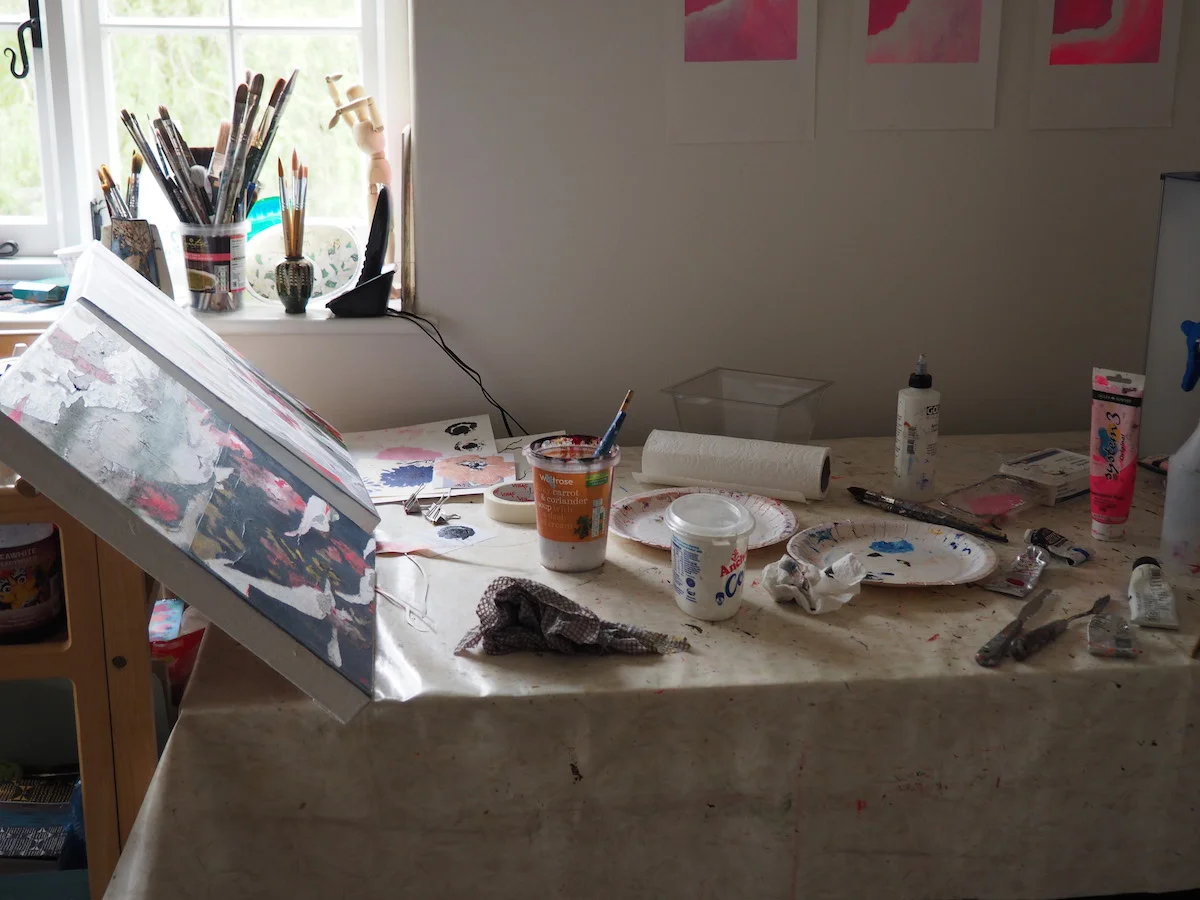
studio table
The rhythm of my days has changed as I move to paint full-time and professionally. It's not just the institutional timetable that has gone away with my academic job, but also the prioritising that had become part of my way of thinking. Released from that, there's a sense of bliss but also a bit of wobbling around in this new big space. Routines that I imposed at the beginning – out of fear that I might waste precious time – are being relaxed and adjusted day by day.
As the weeks go by, I notice yet another set of restrictions that I had placed on myself over the years, absorbed into my mind, and that can now be let go of. It doesn't matter if I paint at 8.30 in the morning or 8.30 in the evening, or both. What matters is that the gesso has dried properly and that the paint is at the right consistency still. There's a rhythm to this work that emerges from doing the work. I am trying to allow its emergence by setting a couple of fixed points in the day (writing in my journal and lunch!), then trusting in the process.
Three questions for an artist

'Daybook', the journal of American artist Anne Truitt, was one of the first books that caught my eye when I unpacked my boxes from store. It spoke to me the first time I read it, and re-reading it now was very moving.
She writes as a woman artist in an art world even more dominated by men than it is now. She writes about her sculpture and painting, and how her art making fits into the span of her life. She writes about her children growing up, leaving home, becoming adults.
I especially love how she describes a key transition in her life as an artist:
I saw my first Barnett Newman, a universe of blue paint by which I was immediately ravished. My whole self lifted into it. "Enough" was my radiant feeling -- for once in my life enough space, enough color ...
...I stayed up almost the whole night ... I decided, hugging myself with determined delight, to make exactly what I wanted to make... What did I know, I asked myself. What did I love? What was it that meant the very most to me inside my very own self?
I wrote out those 3 questions in my sketchbook. The answers will be found in the work.
A studio of my own!

I have moved to Bath from central London - occasionally missing the buzz but more often appreciating the calm. When looking for a place to rent, top of my mind was finding a studio space. Synchronicity helped too - in Greece, I met an amazing American woman who introduced me to scores of lovely people including a couple staying at the hotel. As we talked, the woman and I found more and more life coincidences: Cambridge schooling, mountains in Pakistan, and then Bath. She, it turned out, was buying a house there to live in one day; I was looking for a house to rent.
So here I am.
And the middle floor of the house is making a fine studio. I have covered the floor with heavy duty plastic, unpacked all my paints, brushes and canvases. I have committed to starting each day there, with my journal and second cup of coffee. From writing emerges the work for the day.
Today I am removing an old painting from its stretchers to re-use. I remember painting it at York College, using a Velasquez painting (old woman cooking eggs) as a starting point to explore and transform. I remember noticing the round shapes all through the painting. And the tenderness of the young boy's face. Connecting it to my boys leaving home. From this exercise, I learnt about leaving space.
Next step - stretching canvas for a new painting..